
The International Monetary Fund (IMF) has said India and China will account for half of the global economic growth in 2023, as the multilateral agency retained its growth forecast for Asia's third-largest economy for 2023-24 (FY24). "India remains a bright spot. Together with China, it will account for half of global growth this year, versus just a tenth for the US and euro area combined," the IMF said in its latest update to the biannual World Economic Outlook. Growth in India is set to decline from 6.8 per cent in 2022 (FY23) to 6.1 per cent in 2023 (FY24) before picking up to 6.8 per cent in 2024 (FY25), the global lender said while citing "resilient domestic demand despite external headwinds".

Prime Minister Narendra Modi leaves for Brazil on Sunday for attending the five-nation summit of BRICS nations on July 14 and 15 which is expected to finalise the setting up of a development bank and seek reforms of the United Nations and international financial organisations.

The International Monetary Fund (IMF) on Tuesday cut its economic growth forecast for India to 9.5 per cent for the fiscal year to March 31, 2022 as the onset of a severe second COVID-19 wave cut into recovery momentum. This forecast for 2021-22 is lower than the 12.5 per cent growth in GDP that IMF had projected in April before the second wave took a grip. For 2022-23, IMF expects economic growth of 8.5 per cent, larger than the 6.9 per cent it had projected in April.

The Sensex was mainly dragged by Tata Motors, ICICI Bank, Bharti Airtel and Reliance Industries -- shedding as much as 4.60 per cent.

Will Arundhati Bhattacharya be the RBI's first woman governor? Or will Urjit Patel succeed Raghuram Rajanas RBI governor when his term ends on September 4?

Saudi Arabia has agreed to provide US$ 4.2 billion worth of assistance to cash-strapped Pakistan to support its economy, it emerged on Wednesday after Prime Minister Imran Khan held talks with Saudi Prince Mohammad bin Salman in Riyadh this week.

RBI Governor Raghuram Rajan wanted to improve training for staff, through initiatives such as sending them to other central banks for short stints.

'While growth will bounce back from the current sub-5 per cent, it will stay lower than the already inadequate long-term average of 6.6 per cent,' notes T N Ninan.

The government should not go in for an 'aggressive fiscal consolidation' in the upcoming Budget as global risks have not abated, RBI Monetary Policy Committee (MPC) Member Ashima Goyal said on Wednesday. Goyal further said subsidies are expected to come down as food and energy inflation moderates. WPI inflation in food articles in November was 1.07 per cent against 8.33 per cent in the previous month.

As India's stock rises, the resolution of the border row may become even more difficult, warn Harsh V Pant and Kalpit Mankikar.

Reserves provide a cushion against shocks.

Ahead of the 2023-24 Union Budget, the thinking at the top level of the central government is clear: Gross domestic product (GDP) growth of 6-6.5 per cent is a comfortable enough target for FY24 and the focus should be on fiscal consolidation to ensure that the sovereign cost of borrowing does not become prohibitively expensive in a high-interest rate environment, according to people in the know. Those aware of deliberations between the Prime Minister's Office (PMO) and the Ministry of Finance said while the Budget would look to strike a balance between infrastructure investment and welfare schemes, it is unlikely to be populist, though it will be the last full-year Budget before the 2024 Lok Sabha election. Incidentally, 6-6.5 per cent GDP growth is what the upcoming 2022-23 Economic Survey is expected to project for FY24.
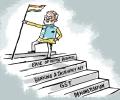
"This is the third year in a row that India makes to top 10 in Doing Business, which is a success which very few countries have done over the 20 years of the project, Without exception, the other countries that have done this are very small, population-wise, and homogeneous," Simeon Djankov, Director of Development Economics at the World bank told PTI in an interview.
"We want a drop in interest rate. This (interest rate) is a huge problem now for us. Real interest rate in India today is touching six percent," Ficci chief Pankaj Patel said, arguing that there should be balance between growth, inflation, and interest rates.

'One way of doing this could be offering credit guarantee to the banks, say 10 per cent, for fresh loans given to micro, small and medium enterprises,' observes Tamal Bandyopadhyay.

Economists warn of the impact that a Fed rate rise could have on emerging economies.

The IMF expressed its opposition to any move that compromises the independence of central banks anywhere in the world.

Those who consider the rupee as a proxy for virility have started thumping their chests and dreaming of dethroning the dollar from its coveted position, observes Tamal Bandyopadhyay.

There is a huge opportunity for foreign investment in India as the government focuses on rapid infrastructure development in the country, Finance Minister P Chidambaram said.

Pro-growth economist Arvind Panagariya has been appointed as first vice-chairman of the newly announced NITI Aayog, which has replaced the Planning Commission.

The Sri Lankan government has appointed an advisory committee comprising eminent economic and fiscal experts to provide guidance on addressing the current debt crisis and engaging with the International Monetary Fund (IMF) and other lenders as the country struggles to combat the unprecedented shortage of foreign reserves.

India's inflation trajectory in the coming months will be influenced more by the geo-political situation due to the war in Europe and its impact on supply chains and commodity prices. However, the country is better placed than most to "weather the storm" and achieve growth of close to 8 per cent in the current fiscal year, the finance ministry said in its latest monthly economic report on Thursday. "Through the channel of imports, elevated global crude and edible oil prices now have a significant impact on India's inflation outlook. "Government measures to keep the prices of these commodities in check, along with the recent hike in policy rates by the RBI, are expected to temper inflationary pressures in the economy," the monthly economic report for April, drafted by the finance ministry's economic division, said.

It came down from $1.94 billion in 2009-10 to $1.17 billion the next year and to $1.11 billion in 2011-12.

India has expressed concern over the hike in visa fee by the US, saying it is "discriminatory" and largely affects Indian IT professionals.

IMF projected India's economic growth at 4.25% in 2013-14.

The US president, who has expressed disappointment over China's handling of the COVID-19 pandemic, claimed that it was the "incompetence" of Beijing that led to the mass killing across the globe.

India's growth projection released by the latest World Economic Outlook remains unchanged from its previous WEO (World Economic Outlook) update of July this summer but is a three-percentage point in 2021 and 1.6 percentage point drop from its April projections. According to the latest WEO update, released ahead of the annual meeting of the IMF and the World Bank, the world is expected to grow at 5.9 per cent in 2021 and 4.9 per cent in 2022.

Pakistan failed to fulfil six of the 27 mandates so far as a result of which the country continues to be in the grey list of the FATF.

Prime Minister Narendra Modi Wednesday said the International Monetary Fund (IMF) sees India as a "bright spot" in the global economy and as per the World Bank, India is in a better position to deal with the global headwinds than many other countries. This is because of India's strong "macroeconomic fundamentals", Modi said while virtually addressing the inaugural function of the 7th edition of Invest Madhya Pradesh-Global Investors Summit in Indore. In the past eight years, the government has increased the speed of reforms and removed many hurdles in the way of investments.

As the states showed progress in fighting the deadly contagion, governors Andrew Cuomo and Philip Murphy have begun to offer details on reopening in the months ahead.

The searches are linked to suspected movement of hawala money during the ongoing polls season and tax evasion.

Stock markets would take cues from the biggest event of the week -- the US Fed interest rate decision, besides tracking the trends in global markets and trading activity of foreign investors, analysts said. Last week, a heavy decline in smallcap, midcap firms, foreign fund outflows and elevated crude oil prices in the international market dented investors' sentiments. Experts said equity markets may remain volatile in the near-term amid a host of global central bank's monetary policy decisions lined up during the week.

It further said India is facilitating external commercial borrowings by startups in order to encourage innovation and promote ease of doing business.

Consumption was the major driver, contributing 58.8 per cent to GDP growth
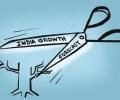
The biggest risk to India's growth outlook is an escalation of geopolitical tensions, especially if these tensions spread to the Asian region, RBI Monetary Policy Committee (MPC) member Jayanth R Varma said on Wednesday. Varma, in an interview to PTI, said that inflation and inflationary expectations appear to be moderating and high inflation will certainly not become the 'norm' in the country. He is cautiously optimistic about the Indian economy as after the pandemic abated, consumption demand has begun to recover though the recovery is uneven across sectors and industries.

The simultaneous decline of several trade-related indicators should put policy makers on guard for a sharper slowdown.

Finance Commission has got new team who are committed to growth initiatives.
FM said every major terrorist incident in the world has a 'Pakistani footprint' around it.

IMF MD Christine Lagarde hailed the government's latest Budget.

The Centre's capital expenditure (capex) outlay for the April-June quarter (first quarter, or Q1) of 2022-23 (FY23) could be close to Rs 1.5 trillion, Business Standard has learnt. As a percentage of full-year capex Budget Estimates (BE) of Rs 7.5 trillion, this could be at similar levels to the trends in the past few fiscal years. It is in the July-September quarter (Q2) of FY23 that capex is expected to pick up, when a bulk of the long-term capex loans to states are expected to be expended.
